

Article
Dimitar Bechev
{
  "authors": [
    "Dimitar Bechev"
  ],
  "type": "commentary",
  "blog": "Carnegie Politika",
  "centerAffiliationAll": "",
  "centers": [
    "Carnegie Endowment for International Peace",
    "Carnegie Russia Eurasia Center"
  ],
  "englishNewsletterAll": "",
  "nonEnglishNewsletterAll": "",
  "primaryCenter": "Carnegie Russia Eurasia Center",
  "programAffiliation": "",
  "regions": [
    "Russia",
    "Western Balkans",
    "Europe"
  ],
  "topics": [
    "Foreign Policy",
    "EU Foreign Policy",
    "Security"
  ]
}
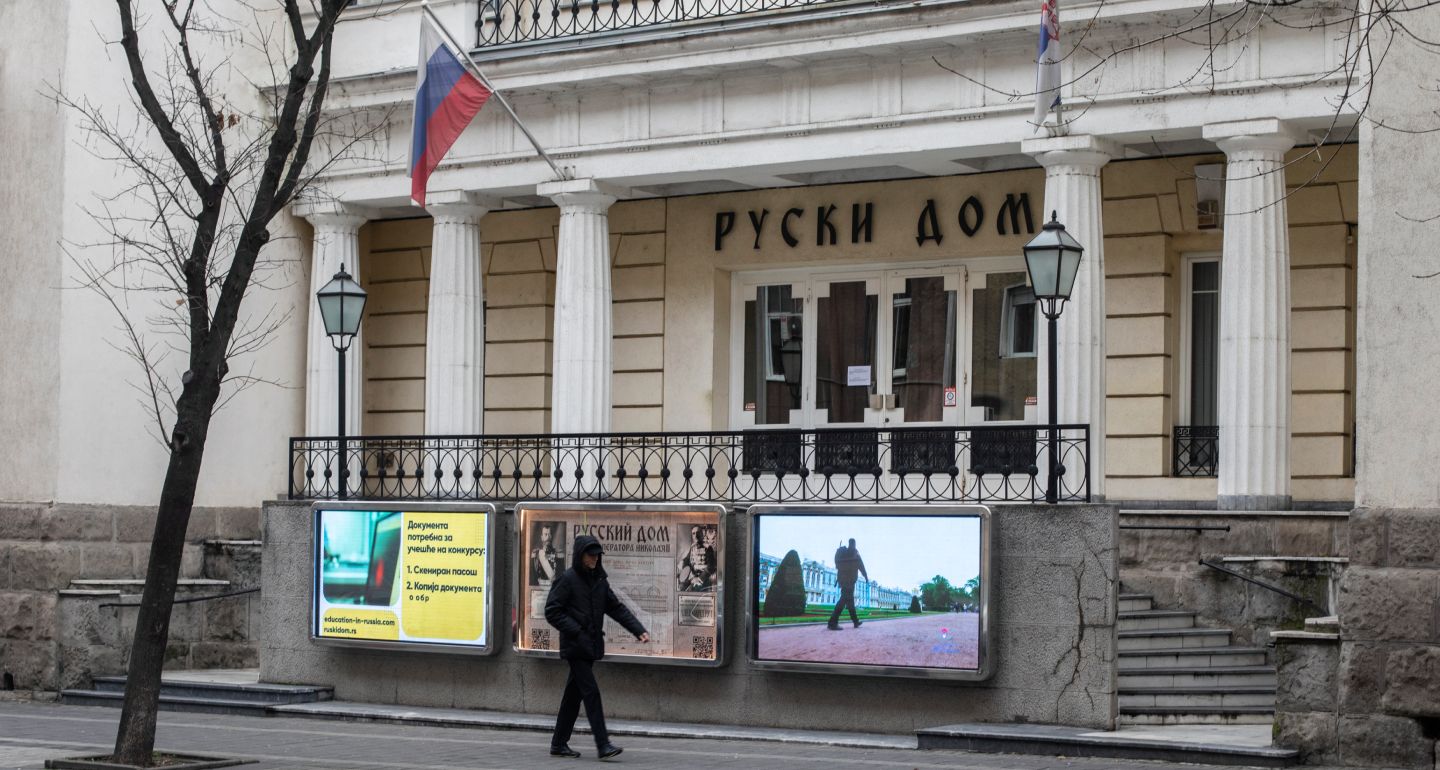
Фото: Getty Images
It’s a testing time for Russia’s policy in Serbia and the wider region, but it would be premature to conclude from one political setback that the days of Russian influence are over.
Is Russia a spent force in the Balkans now that Aleksandar Vučić has lost power in Serbia? There is reason to believe that the Kremlin will miss the Serbian strongman. For close to fourteen years, Vučić invested in economic and political ties with Russia. After February 2022, Serbia was one of the few countries in Europe that refused to join Western sanctions against Moscow.
Despite insisting that EU membership remained a strategic goal, in 2025 Vučić attended Moscow’s Victory Day military parade commemorating the end of World War II to rub shoulders with Russian President Vladimir Putin and China’s Xi Jinping. Vučić took the opportunity to thank the Russian leader for standing with the Serbian government in fighting against yet another Western-backed color revolution, as he described anti-government protests. That narrative was echoed by senior Russian officials such as Foreign Minister Sergey Lavrov and Kremlin spokesman Dmitry Peskov.
Now that the revolutionaries have won—prevailing by a huge margin in a snap election called by Vučić himself, rather than through street protests—Moscow’s narrative has been wrongfooted. It’s a testing time for Russia’s policy in Serbia and the wider region, but it would be premature to conclude from one political setback that the days of Russian influence are over.
First, Vučić was what the Soviets called a “fellow traveler” (meaning someone sympathetic to their cause, at least when the going was good) for Russia, rather than a bona fide ally, and struck a balance between Moscow and Kyiv. Under his leadership, Serbia supplied Ukraine with ammunition and, at least rhetorically, supported its territorial integrity. Ukrainian President Volodymyr Zelensky was in Belgrade in early August, discussing with Vučić—then Serbian president—and Prime Minister Ðuro Macut issues such as EU integration.
In addition, Belgrade has diversified its relations beyond the EU, shifting the focus from Russia to China and the United States under President Donald Trump. China is the largest single-country investor in the Serbian economy, with overall FDI stock of nearly 8 billion euros, or 16 percent of the total. Xi made Belgrade one of the stops of his European tour in the summer of 2024.
Last July, the outgoing Serbian foreign minister, Marko Ðurić, inaugurated a partnership with his U.S. counterpart Secretary of State Marco Rubio. Serbia also has thriving partnerships with the UAE, Israel, and Azerbaijan. The pro-Russian line in pro-Vučić media aside, Belgrade’s relationship with Moscow has never been exclusive.
Second, the Student List party that won the October 25 election is not looking to dramatically renounce Russia. Prominent Student List figures, including its lead candidate Ilija Srdanović, have been trying to sweep the issue under the carpet, insisting on an “open dialogue within Serbian society.” That is understandable, since the question of Serbia’s geopolitical orientation raises the risk of splitting the hitherto cohesive anti-Vučić bloc into nationalists and liberals.
The new government’s priority will be to carry out ambitious reforms in order to dismantle Vučić’s clientelist networks and build transparency and accountability. The closure of Alta Banka, where many Russians deposited cash, was about corrupt practices linked to the Serbian Progressive Party (SNS), not foreign policy. Nor will Serbia alter its position on the independence of Kosovo—and it will therefore still be reliant on Russian support in the UN and other international platforms.
Serbia’s new leadership expects that its efforts to restore the rule of law will bring dividends on the EU integration front. Student List could also bring about change in how Serbian media portray international affairs. As Vučić’s loyalists lose control, impassioned headlines praising Russia and Putin and sharp criticism of the EU will give way to a more neutral tone. Eminent Kremlin-lovers like former deputy prime minister Aleksandar Vulin or Srbijagas head Dušan Bajatović, tainted by their association with the former regime, won’t be getting as much play as before either.
As a result, support for the EU might increase, albeit from a relatively low starting point. But all this change of optics and language should not be mistaken for a substantive policy shift.
A third and related factor is that energy links will persist. Srbijagas and Gazprom are in the process of negotiating a new contract, since the current one expires at the end of this year. Student List’s Dejan Radivojević has said that the new contract should be a long-term one.
While EU legislation mandates an end of pipeline shipments of Russian gas on September 30, 2027, it exempts transit. In other words, the TurkStream pipeline supplying Serbia through Bulgaria will continue to operate. While neighboring Hungary will have to stop purchases, Srbijagas, along with other companies in the Western Balkans, could go on buying from Russia.
It is much the same story with oil. NIS, the Gazpromneft-owned national company running Serbia’s sole refinery at Pančevo, is likewise operating unimpeded. On October 30, the U.S. Treasury’s Office of Foreign Assets Control (OFAC) granted NIS yet another exemption from the sanctions imposed at the tail end of the Joe Biden administration in January 2025.
In next-door Bulgaria, Lukoil Neftochim has also been given a reprieve by both the United States and the UK from the sanctions signed off by Trump in October 2025. The company supplies a network of 112 gas stations and two depots across Serbia, the second largest after that run by NIS. Although Lukoil Neftochim mainly processes Kazakh rather than Russian crude these days, the fuel once again comes from the CPC pipeline and the port of Novorossiysk.
All in all, Russian business has not taken a hit from Vučić’s departure. So long as the United States is not pressing hard for NIS and Lukoil’s subsidiaries to be sold off, it is all business as usual.
Fourth, Vučić is down but not out. Having lost the latest round, he is likely mulling his eventual comeback to power. On social media, Vučić is cultivating the image of a man of the people, getting on with his life, socializing with SNS party members, and enjoying the small pleasures the everyday routine of a fifty-something has to offer. He is also signaling he has nothing to worry about when it comes to potential investigations of high-level corruption and abuse of power.
Vučić could be betting on a scenario in which Student List falls prey to internal squabbles and splintering, causing the pendulum to swing back his way. Expectations in society for rapid positive change could well produce a great deal of disappointment.
If SNS succeeds in retaining some of its base, as well as power at the local level, it might get an opportunity to seize power again, outmaneuvering the Student List or whatever it morphs into. If that happens, Russia will once again have a more or less reliable partner in Belgrade.
Last but not least, Serbia’s election was not the only one. On October 25, the same day as Vučić was toppled, Bulgaria also went to the polls to vote for a new president. A Russia-friendly candidate, Iliana Yotova, won the runoff a week later. Now Prime Minister Rumen Radev has consolidated his control of Bulgarian foreign policy.
That benefits Russia. Bulgaria has been arguing for EU negotiations with Russia and resetting economic ties in the name of de-escalation. It has dragged its feet in calling out Moscow for the strikes against commercial ships in Bulgaria’s exclusive economic zone in the Black Sea and for hybrid attacks on land, including against ammunition depots and a Starlink terminal near Sofia.
Yotova accused her opponent Andrey Gyurov of working to drag the country into the Ukraine war, a strategy that former Hungarian prime minister Viktor Orbán once deployed against the opposition. Despite the low turnout of just 28.9 percent on November 1, the Bulgarians sided with Yotova. Having not quite lost Serbia, the Kremlin has won Bulgaria, a frontline EU and NATO member.
The moral of these two stories is that Russia cannot be turfed out of the Balkans. Moscow might be playing second fiddle to the EU and the United States, but it remains embedded in politics and the economy. It is entirely possible to contain its influence, but getting rid of it is another matter.

Senior Fellow, Carnegie Europe
Dimitar Bechev is a senior fellow at Carnegie Europe, where he focuses on EU enlargement, the Western Balkans, and Eastern Europe.
Recent Work
Dimitar Bechev
Dimitar Bechev
Carnegie does not take institutional positions on public policy issues; the views represented herein are those of the author(s) and do not necessarily reflect the views of Carnegie, its staff, or its trustees.
There are limits as to how far the shift in South Korea’s foreign policy will go.

James D.J. Brown
A gas deal would create palpable economic value, but it wouldn’t fundamentally change the position of either Russia or the EU.
Sergey Vakulenko
Russia’s banking sector is sinking ever deeper into a crisis that the authorities are simply managing rather than trying to fix.
Alexander Kolyandr, Alexandra Prokopenko
The war does threaten Putin’s existence. That is why he does not negotiate.
René Nyberg
Russia’s coveted Red Sea naval base has fallen victim to its erratic foreign policy.
Sergey Konyashin